How Modernized Auto Shop Customer Service Sells More Repair Work
The article discusses how modernized customer service strategies, including the use of cloud-based SMS communication and standardized processes, enable auto repair shops like Metro Motor to increase their average repair order value and sell more maintenance work across multiple locations.
By default, we use third-party cookies in order to personalize your experience. Read our Cookie Policy.
Accept
Preferences
Manage Consent Preferences
Essentials
Always active
Necessary for the site to function. Always On.
Analytics
Analytics
Measures usage and improves your experience.
Marketing
Marketing
Used for targeted advertising.
Personalization
Personalization
Remembers your preferences and provides enhanced features.
The GPC signal has been honored.
Reject All
Accept All
Thank you! Your submission has been received!
Oops! Something went wrong while submitting the form.
Preferences
Join 1,000+ industry leaders at Tektonic 2027. Early bird pricing is now open.
See how Metro Motor grew their average repair order to $800 across 19 shops with Tekmetric
Under the Lift: Stories from the Automotive Frontier (New Episode)
Register Now Read the Story Watch Now
Modern Auto Repair Shop Customer Service Sells More Maintenance Work
|
May 15, 2023
|
Read time: 1 min

 \
Add as a preferred source on Google
\
Add as a preferred source on Google
Latest Posts
Reading the ARO Gaps Among Your Shops
How to Deliver a Consistent Auto Repair Customer Experience Across Every Location
Auto Repair Platform Features that Actually Matter
Grow Every Multi-Shop Location
table of contents
https://www.tekmetric.com/post/auto-repair-shop-customer-service
Drivers typically come in with an expectation of what's wrong with their car, which can make it tricky to sell maintenance work. They might think you're trying to squeeze more money out of them, or may simply have a set budget in their mind and don’t plan on spending extra.
In reality, you're simply trying to go above and beyond and provide them with the best service possible. So how do you show that, and which tools will help you transform the way you sell maintenance?
Here’s how to build customer trust while staying true to your auto repair shop’s mission of providing optimal maintenance recommendations.
Why Selling Maintenance Work is a Challenge
According to a survey conducted by AAA, 76% of U.S. drivers said that recommending unnecessary services was the top reason they do not trust auto repair shops.
The survey also points out that ⅔ of U.S. drivers have managed to find an auto repair shop that they trust. That makes it harder for your shop to convince them to pay for an expensive yet critical repair, let alone get them to pay extra to replace filters, change oil, and refresh fluids.
Service advisors may be hesitant to sell maintenance work and only focus on the problem at hand because they don’t want to come off as pushy. And that's for good reason, as we know most customers don't view auto repair shops as a helpful service, but sometimes a pit of endless expenses.
We're here to help break that cycle, and help your shop sell even more maintenance work just by focusing on the customer experience.
Why Improving Your Shop's Customer Service Can Go a Long Way
Regular maintenance makes your customers’ lives easier and saves them money in the long run. It prevents your customers from ending up on the side of the road and prolongs their vehicles’ lifespans. But more importantly, maintenance work can be an easy win for your shop to provide a modern customer experience, with exceptional customer service.
-
Because digital vehicle inspections make it easy to show customers what's wrong with their car, customers will trust you more. When you provide reliable insights into your customers’ vehicles, you’re their go-to car whisperer—a trustworthy person who reminds them to check stuff out on their vehicle before anything bad happens.
-
Providing maintenance inspections helps shops sell more work, which usually means higher ROs and a more profitable repair shop. Also, because maintenance work helps your customers’ vehicles last longer, they’re less likely to buy a new car and instead keep bringing their current car back to your shop.
-
Maintenance inspections help you queue up more work for the future. Even if they decline the maintenance work, you now have a relationship. You can track those declined jobs, and the service advisor and technician can save time figuring out what all might be wrong with the vehicle and resell that work.
Modern Shop Management System Features Help Sell More Work
Of course its standard practice for shops to always check and note the mileage of vehicles both as they roll into the shop and when they roll out. And we recommend your shop keeps that up.
But we're here to help make great shops even better. Independent auto repair shops can leverage features like default inspections and canned jobs to create a standardized intake process for all vehicles that roll into their shop.
With default inspections, shops can build inspection templates to cover standardized checkpoints, which can include maintenance items based on the life or mileage of the vehicle.
After the car has been inspected, shops can use canned jobs to instantly generate repair orders based on the findings in your default inspection.
For example, if the car rolls in at 62k miles, and your shop checks coolant levels at every 20k miles, your technician might recommend a coolant flush and replacement. If the work is approved approved, that canned jobs for a coolant flush can be quickly added to the repair order.
Pro-tip: be sure to include a picture of how dirty the coolant is so customers can see why it should be replaced!
Improve your Shop's Customer Service with a Standardized Process
Now, different shops servicing different vehicles may have different standardized maintenance timelines. We've seen shops create a standardized template for maintenance work based on mileage that usually includes:
Every 3,000 - 7,000 Miles
- Replace oil and oil filters, inspect various fluid levels and wipers, check tires and lights
Every 15,000 miles
- Replace air filter
Every 20,000 miles
- Inspect battery and coolant levels
Every 30,000 miles
- Replace power steering fluid, inspect coolant levels, brake pads, and suspension components, check radiator hoses and HVAC system
Every 35,000 miles
- Inspect and replace the battery
Every 40,000 miles
- Replace spark plugs and wires, inspect ignition system and suspension
Every 60,000 Miles
- Replace brake pads and fluid, inspect radiator hoses, timing belt, HVAC system, suspension components, and tires, check coolant levels, and power steering fluid levels
Auto Repair Shops Can Sell More Starts with the Best Customer Service
Selling maintenance work can be challenging due to customers’ skepticism and reluctance to spend extra money. Selling even critical repair work is hard when people don't trust auto repair shops because of bad experiences, or horror stories.
Cars are expensive, complicated, noisy, and unintuitive to most people who drive them, the exact opposite of everything consumers look for in their products and solutions.
But that's exactly why your shop exists! To help them take care of the costly, sometimes difficult repairs so they can get back to their lives, whether that’s bringing the kids to soccer practice or getting to work on time!
That's why it's so critical for auto repair shops to focus on customer service, and offering customers an experience they can trust with a transparent inspection and sales process. One that makes the often painful, expensive process of getting their car fixed as simple, easy, and painless as possible.
👉 Ready to grow your automotive business? [Book a personalized Tekmetric Demo Here]
FAQ
More articles
Expanding your business into multiple locations is exciting but can come with challenges. One of these challenges being, the ability to manage data and reports across all of your shops.
To simplify this process, Tekmetric has developed Multi-Shop, our most powerful set of tools and reports to easily manage multiple shops through custom shop comparison reporting, organization-level reports and centralized data management.
Multi-Shop allows you to gain back time, make better business decisions and maximize your margins.

Product Updates
How to Manage Your Shops Using Tekmetric Multi-Shop
May 22, 2023
Read time: 1 min
Parts management is a critical function of any auto repair shop business. The only way to guarantee that you’re making a profit on the parts you sell on repair orders is by having an air-tight system for managing and tracking those parts from purchase to sale to reconciliation. The final step of making sure that each and every parts transaction is accounted for is probably the most important step—and the most misunderstood.
Some of the issues your auto repair shop will run into if you don’t carefully manage parts include:
- Un-billed parts (forgetting to collect payment on parts)
- Inconsistencies between your cost of goods sold and accounts payable
- Inability to track and receive return credits
- Inability to detect theft before it gets out of hand
Many of these issues can be avoided by using purchase orders to reconcile the parts you sell on repair orders.
But many auto repair shop business owners still wonder what some of the best practices are when it comes to parts management. How often should you be reconciling parts payments? Who should take on this task: you, your service advisors, or a dedicated parts manager? How do you make sure you’re getting the best value for the parts you buy and sell? How do you ensure that each and every part is being billed?
Let’s answer some of these questions, and unpack the best practices for parts management.

Thought Leadership
Best Practices for Parts Management & Reconciliation
June 1, 2023
Read time: 2 min
Tekmetric standardizes how every auto repair shop operates
Running multiple shops should mean more revenue, more repair orders, and more momentum. For most MSOs, it also means more complexity, inconsistency, and time spent putting out fires instead of building the business.
The problem isn't growth. It's that most shop management systems weren't built for it. Separate logins for each location. No unified view of revenue or performance. Processes that drift from shop to shop until every location is running differently and nobody can figure out why the numbers don't match. Tekmetric fixes that at the root — one platform, every location, standardized from day one.
Tekmetric shops see measurable revenue growth as they adopt platform features. Shops average $612 per repair order (ARO), but that number climbs to $741 when they use Digital Vehicle Inspections and reaches around $800 when they add MotoVisuals videos. The lift isn't about charging customers more; it's about transparency, showing them what their vehicle needs so they can make confident, informed decisions. It also builds trust.
The operators running on Tekmetric show what that looks like in practice. Main Street Auto, a nationwide network of community-rooted shops, grew from six locations to more than 115 with Tekmetric at the core of every one. Rush Automotive, in Austin, Texas, saw $9,000 in new revenue in the first month across five locations. CarTech Auto Center, operating across multiple locations in Puerto Rico, grew monthly revenue 48% in nine months. The platform didn't change their ambition. It gave them the infrastructure to act on it.
Customer Experience
Customers Don't Know Which Location Is Your Best. Tekmetric Ensures They Can't Tell the Difference.
Inconsistencies across locations cost you. Skipped DVI photos, estimate delays, and declined jobs that nobody follows up on quickly add up, decreasing your revenue, and negatively affecting customer experience.
The shops that grow their ARO, earn repeat business, and generate the kind of reviews that actually drive traffic all share the same foundation: customers trust them. And trust isn't built in a single interaction — it's built through consistent, transparent communication every single time a vehicle comes in.
Tekmetric gives you the tools to make that consistency automatic. Inspections follow the same template at every location, with photos and video built into the estimate. Customers get their quote by text, approve the work from their phone, and can pay before pickup with Tekmetric Payments built in. Text-to-Pay, card-on-file, and Buy Now, Pay Later options make checkout faster and remove friction from bigger approvals. Their vehicle history travels with them, so when a customer visits a different one of your locations, whoever's at the desk already knows their vehicle history.
With Tekmetric Marketing running in the background, customers get automated appointment reminders, follow-ups on declined services, and service reminders based on real vehicle data. Online booking lets them schedule service 24/7 without picking up the phone. Google Review requests go out automatically after every completed service, turning great work into lasting reputation.
When shops share eight or more inspection photos with customers, ARO goes up because customers can see the repairs their vehicle needs. Euro Car Doctors, in Orange County, Calif., used that approach and grew their average ARO to more than $900. Garagisti, in Houston, Texas, built a practice around transparent, DVI-driven customer communication from day one and has averaged a $1,600 ARO since opening.
What This Looks Like in Practice
- Standardized DVIs, streamlined customer communication, and shared vehicle history across every location so every customer gets the same experience regardless of which shop they walk into
- Text-to-Pay and Buy Now, Pay Later built into checkout to speed up payments and boost approval on bigger repairs
- Automated follow-up on declined services and service reminders that run from real vehicle data, not generic time intervals
- Online booking available 24/7 so customers can schedule service without waiting for business hours
- Google Review requests sent automatically after every completed service — no manual steps required
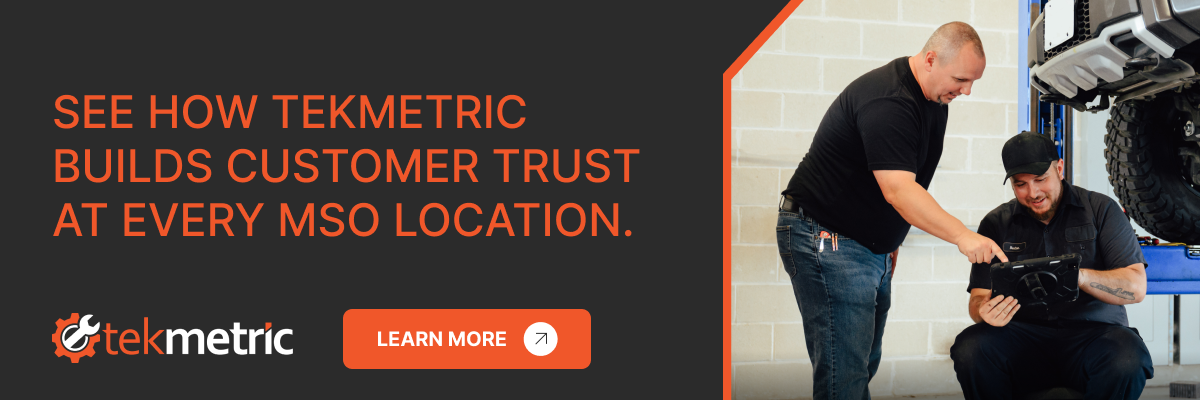
Permissions & Access Roles
Tekmetric Puts the Right Data in Front of the Right People Across Every Location
When you add a location, you're not just adding bays, you're adding staff, risk, and the need for accountability at a distance. The right access structure makes all three manageable.
Most MSOs hit a wall when they try to manage growing teams without the right controls in place. Too much access creates risk such as errors in repair orders, incorrect discounts, and sensitive financial data visible to people who don't need it. Too little creates friction, leaving advisors waiting on approvals, technicians without job visibility, and managers unable to make calls on their own.
Tekmetric gives you granular, role-based controls across every location. Technicians see their job queue, their assignments, and their hours. Managers have what they need to run their shop without touching another location's data. Advisors can build estimates, communicate with in-store customers, and process payments. Owners see the full portfolio in real time from a single login.
Before switching to Tekmetric, Will Rivera, owner of CarTech Auto Center in Puerto Rico, had to log into each of his five stores separately just to check sales or inventory. There was no unified view of the business, no way to enforce consistency, and no clean data to make decisions from. Within nine months of switching, CarTech had grown monthly revenue by 48%. Once CarTech had the structure to run five locations cleanly, expansion became the goal instead of survival.
What This Looks Like in Practice
- Owner, manager, service advisor, and technician roles with granular, customizable permissions that are set up once and applied consistently at every location
- Cross-location visibility for owners and ops leaders, with shop-level access for everyone else. Accountability is built into the platform and not enforced manually.
- Controlled access to sensitive actions like unposting ROs, giving the right people the ability to correct errors without opening the door to bigger ones

Change Management
Switching Shop Software Doesn't Have to Disrupt Your Business. Here's How MSOs Make It Work.
Adopting new software across multiple locations is a real operational challenge. Tekmetric is built for it, from contract to live in a few days.
Christian Brothers Automotive migrated about 200 stores to Tekmetric in three months. Main Street Auto onboards 20 to 25 new locations a year and keeps growing. These aren't small transitions executed by large IT teams — they're operational rollouts managed by auto repair shop employees, built around Tekmetric's onboarding process.
Every new Tekmetric customer gets a dedicated onboarding manager who builds a rollout plan around your schedule, not a generic timeline. Data migrates. Workflows get configured. And most teams are fully operational within a week of going live, with results measurable within 30 days. That's not a promise. It's a framework Tekmetric has built and refined across thousands of shop launches.
The platform itself is designed to be learned fast. SJ Automotive cut estimate creation time from 40 minutes to about 10 minutes after switching. That's not a team that spent weeks in training. That's a team that picked up an intuitive tool and immediately got more done. When the platform is easy to use, adoption isn't a change management project. It's what happens when the tool earns buy-in on its own.
What This Looks Like in Practice
- A dedicated onboarding manager, data migration support, and a go-live timeline built around your shops, not a one-size-fits-all playbook
- An intuitive platform with a training hub, knowledge base, and U.S.-based support, so your team gets productive fast and stays that way
- Access to the Tekmetric User Group, a community sharing what works, so you grow alongside operators who have already been where you are

Inventory & Parts Sharing
Stop Paying for Parts You Already Own. Tekmetric Gives Every Location Real-Time Visibility Into Stock.
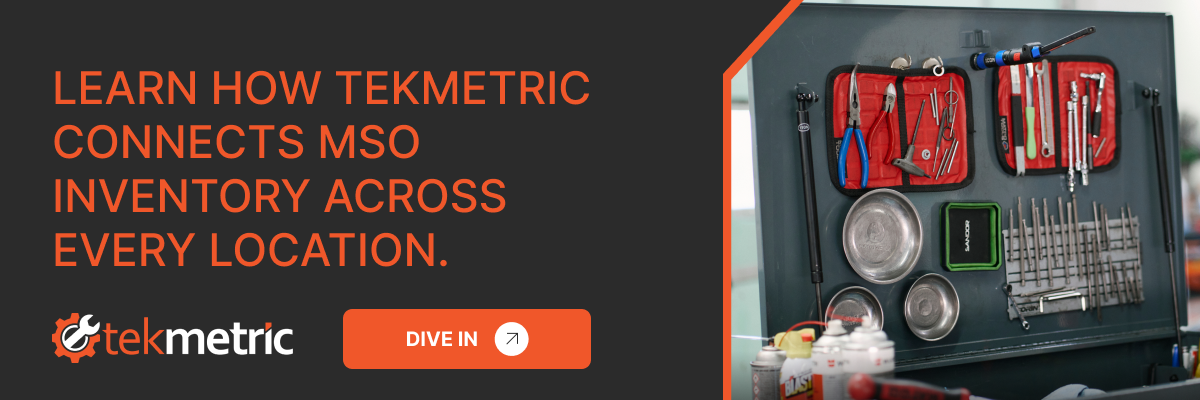
When parts data is fragmented across locations, technicians wait, repairs get delayed, and margin slips through the cracks. Tekmetric centralizes inventory across every shop so your team always knows what's in stock, what's on order, and where to find it.
Multi-location inventory has a way of quietly breaking down. Parts get ordered twice because one location didn't know another had them. Technicians start jobs they can't finish. Reconciliation eats hours at the end of every month. The fix is straightforward: one centralized view of what's in stock across every location, updated in real time.
With Tekmetric, every authorized user sees real-time parts availability across every location. Orders happen directly inside the repair order — no supplier portal, no manual entry, no switching systems. When a technician picks up a job, they can see immediately whether parts are in stock or on order, so they're never starting work they can't complete. And when inventory hits a minimum threshold, reorder alerts surface automatically.
What This Looks Like in Practice
- Real-time parts visibility across every location, connected directly to the repair order workflow so technicians, advisors, and managers always know what’s in stock
- Parts ordering through PartsTech and others, directly from inside the RO. No portal toggling, no duplicate entries.
- Automatic reorder alerts, purchase order tracking, and parts usage reports that give ops leaders a clean view of inventory performance across the portfolio
Profitability & Reporting
The Gap Between Your Best Auto Repair Shop and the Rest Isn't a Mystery. It's a Data Issue.
You know which locations perform. Tekmetric shows you exactly why, in real time, so you can act before the day is done.
Most MSOs are managing with last week's numbers at best. Reports get built manually. Data gets pulled from separate systems. By the time you know there's a problem at a location, the opportunity to act quickly and solve it is gone. That lag doesn't just slow down your decisions, it costs you money in real time.
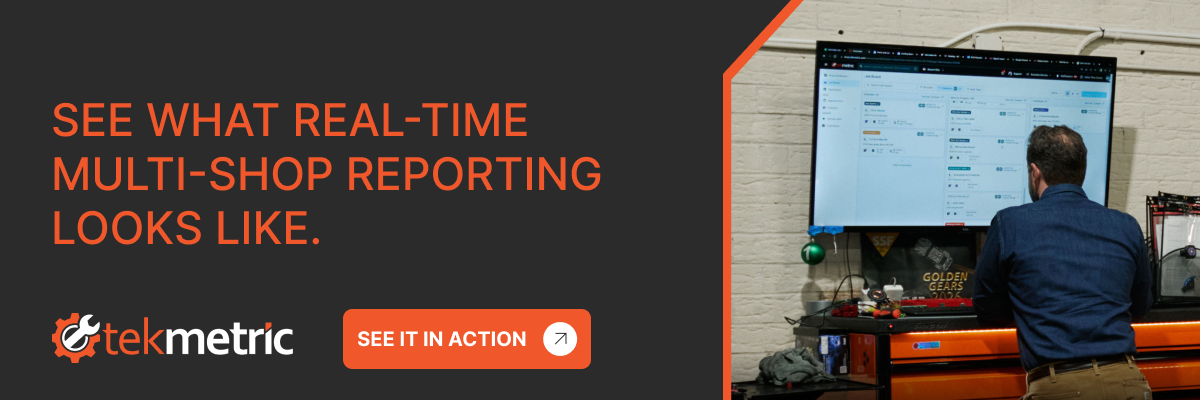
Tekmetric's portfolio dashboard puts every location's data in one live view. ARO, car count, close ratio, gross profit, and technician efficiency are all filterable by shop, advisor, and date range, giving you a complete picture of what's working and where the gaps are. Seeing your top performer and your underperformer side by side makes it clear exactly what the best shop is doing that the others aren't.
The operators who use this visibility don't just track results — they act on them. Branch Automotive used Tekmetric's real-time data to build nine straight month-over-month increases in ARO, driven by stronger inspections, clearer recommendations, and the kind of customer trust that leads to consistently higher-value work. These aren't outliers; they're what happens when operators finally have the data to make better calls.
What This Looks Like in Practice
- A portfoliowide dashboard showing ARO, car count, close ratio, and gross profit across every location in real time with shop-level filtering so you can see the full picture or drill into one location
- Built-in reporting on technician productivity, DVI impact on ARO, end-of-day reconciliation, and discount and fee analysis — no exports, no spreadsheets, no five-hour Friday afternoon
- Labor and parts matrices that lock in consistent pricing across locations, protecting margins and making every shop’s numbers comparable
.png)
No items found.
Grow Every Multi-Shop Location
August 18, 2026
Read time: 9 min

Request a personalized demo now
experience
Tekmetric in Action
.svg)


.svg)

.svg)
.svg)
.svg)
.svg)
.svg)
.svg)
Platform
Features
- Digital Vehicle Inspections
- Estimate Building
- Parts & Inventory
- Phones
- Reporting
- Payment Processing
- Invoicing
- Text-To-Pay
- Buy Now, Pay Later
- Capital Financing
- Online Booking
- Automated Reminders
- Scheduled Campaigns
- Two Way Texting
- Google Reviews
- Websites
Resources
Support
- help center
- Contact Us
- Tek User Group
- Faqs
- System Status
- Email Preferences
- Brand Assets
- Trust Center
company & Legal
-
Careers we are hiring!
×