How Automotive Repair Software Fuels Multi-Shop Growth
The article discusses how automotive repair software, exemplified by Tekmetric, enables multi-shop businesses like Metro Motor to standardize operations across multiple locations and significantly increase their average repair order value, thereby fueling growth and efficiency in the automotive repair industry.
By default, we use third-party cookies in order to personalize your experience. Read our Cookie Policy.
Accept
Preferences
Manage Consent Preferences
Essentials
Always active
Necessary for the site to function. Always On.
Analytics
Analytics
Measures usage and improves your experience.
Marketing
Marketing
Used for targeted advertising.
Personalization
Personalization
Remembers your preferences and provides enhanced features.
The GPC signal has been honored.
Reject All
Accept All
Thank you! Your submission has been received!
Oops! Something went wrong while submitting the form.
Preferences
Join 1,000+ industry leaders at Tektonic 2027. Early bird pricing is now open.
See how Metro Motor grew their average repair order to $800 across 19 shops with Tekmetric
Under the Lift: Stories from the Automotive Frontier (New Episode)
Register Now Read the Story Watch Now
How to Find An Automotive Repair Software That Supports Your Multi-Shop Growth
|
January 17, 2023
|
Read time: 2 min
-min.webp)
 \
Add as a preferred source on Google
\
Add as a preferred source on Google
Latest Posts
Reading the ARO Gaps Among Your Shops
How to Deliver a Consistent Auto Repair Customer Experience Across Every Location
Auto Repair Platform Features that Actually Matter
Grow Every Multi-Shop Location
table of contents
https://www.tekmetric.com/post/automotive-repair-software-multi-shop-growth
Let’s start off by laying down the foundational launching points for starting your original shop: you found your niche, you got the right advice, you started with the right branding, and you impressed your customers by providing exceptional customer service. But there are four key factors that become extremely important as you go from being a single shop owner to a multi-shop owner.
You’ll want to:
- 1.Stay organized as you scale
- 2.Create consistency across your locations
- 3.Test the performance of each of your locations
- 4.Leverage an automotive repair software that will support your team as you grow across multiple locations
To select the management tools that will catapult your multi-shop owner journey, you’ll first need to weigh the pros and cons of each of your shop’s processes and procedures.
From there, you can find a system that will uphold and scale the processes that made your shop so successful in the first place, but now across multiple locations. Later in this article, we’ll specifically dive into automotive repair software like Tekmetric and discuss how it supports you, your team, and your customers as you go from a single shop owner to a multi-shop mastermind.
Here’s how to choose an automotive repair software that makes it possible to grow and easily manage multiple shops.
First Things First: Get Your Shop’s Operations Down
Opening up multiple auto repair shops isn’t effortless. It takes hard work and diligent planning. You’re likely to encounter challenges along the way, especially if your shop doesn’t have its operations and systems down pat before expanding.
According to Automotive Research%20and%20finding%20good%2C%20knowledgeable), the biggest challenges for automotive repairs shops and their technicians include finding time for hands on training (42.6%), staying up to date with advances in diagnostics (31.6%), keeping up with advances in vehicle technology (31.1%), and finding good, knowledgeable and motivated technicians (29.2%).
Before you consider expanding to multiple locations, your existing shop should be stable, profitable, and running smoothly. If you still have problems with your current shop, they will be magnified into even larger growing pains when you expand. Your best bet is to resolve as many problems and get everything in order before making the leap from a single auto repair shop owner to a multi-shop owner (MSO). With the right automotive repair software, you can carefully stabilize your shop’s operations and monitor where you’re at in terms of profitability, customer retention, and facing current and future challenges.
Once your shop’s operations are organized and tested, it’s time to hone in on change management. Change management is a collective term for any and all approaches when it comes to preparing, supporting, and helping your business grow. There are many different approaches to change management, but for auto repair shops expanding to multiple locations, there are often three major phases: The Planning Phase, The Implementation Phase, and The Impact Phase.
The Planning Phase: Map Out Decisions That Align With Your Goals
The planning phase happens during or after you’ve realized that your shop could have better systems and processes in place to expand beyond one location. According to MindTools, the planning phase usually consists of the following four elements:
- 1.Sponsorship: How will you secure, engage, and use high-level support to sponsor the change?
- 2.Involvement: Who is best positioned to help you design and implement the change? For example, will you need external expertise? Or can you use internal resources?
- 3.Buy-in: Change is most effective when you are able to win support from people across the business. How do you plan on winning the support of your team?
- 4.Impact: Finally, think about what success should look like. How will you predict and assess the impact of the change that you need to make? What goals do you need to achieve?
You might find that you need to make some changes before expanding to multiple locations, and expanding to another location is a big change in itself. So naturally, as your shop expands, you’ll be faced with big decisions: What system will you use at the new location? Who will manage the new location? How will you support the growth of both locations simultaneously? The choices you make should all support and achieve your future goals, but you need to know what those goals are.
Twelve Questions To Ask Yourself During The Planning Phase
Before you opt for opening that second, third, or tenth shop, make sure you ask yourself these questions:
- 1.Is our current shop’s demand higher than we can handle?
- 2.Has our shop’s ARO hit a plateau?
- 3.Can we afford to hire and pay an entirely new team?
- 4.Is our current shop overwhelmed during peak business hours?
- 5.Do we have automotive repair software that can support more than one location?
- 6.Have we reached our desired profitability rates?
- 7.Have we reached our shop’s capacity limitations?
- 8.Have we run out of space to serve all of our customers?
- 9.Are our shop’s profits stable?
- 10.Is there a big enough market in the area for another location?
- 11.Can I handle operations for more than one shop?
- 12.Is my current team trained so that we can focus on training an entirely new team?
If you are able to positively answer each of those questions, it might be time to open up the next location.
Want to hear from auto repair industry leaders that have been faced with growing pains but have come out stronger than before? Check out our customer's success stories!
The Implementation Phase: Put Your Change Into Practice
During the implementation phase, you’ll want to carry through with the plan you created during the planning phase. Setting goals and expanding with intention can help any business succeed and meet their overall strategic vision.
Once you’ve figured out the four elements of the planning phase (sponsorship, involvement, buy-in, and impact), your game plan is mapped out, and you’re ready to hit the ground running. The implementation phase is all about building momentum and keeping it going so that you get your supporters—business partners, team members, and even customers—behind the changes you're making.
Now, keep in mind that you need to keep implementing with intention throughout the entire change management process. If you aren’t mindful of how the decisions you make will impact your progress, your hard work could encounter more setbacks than successes along the way.
Tekmetric Co-CEO Sunil Patel explains it perfectly:
“Let’s say you set a goal for yourself to go to the gym more often. Now, if you don’t want to go to the gym, then you will keep training your mind to make sure that gym is just not your thing. It’s not until you have a breakthrough that you are able to change your mindset. You have to train your Reticular Activating System (RAS), a network of nerve pathways located in the brain stem that mediates overall behavior, so that going to the gym becomes a positive activity.
Along with reminding yourself that you want to go to the gym, write down when you want to make the change and why. Let’s say this is your goal, ‘In March 2023, I will feel great, I will look great, my clothes will fit me better, and I can hear my family and friends saying ‘You’ve done a fantastic job.’ You have to recognize and reframe each limiting belief that is preventing you from achieving your end goal. An example of a limiting belief would be something along the lines of, ‘Ah, I’ve had a long day. I can just go to the gym tomorrow.’ You have to reframe it to, ‘I’ve had a long day. Time to finish strong with a trip to the gym.’ You have to be very intentional. You truly have to want to reach the finish line.
This concept goes for shop owners, too. If you’re wanting to expand your shop, you’ll need to change the way you’re running your business.”
The Impact Phase: Expand Into New Territories
Once you’ve mapped out your course of actions and you’ve intentionally implemented the changes, then you’re ready to see how all of your hard work has impacted your business. This final phase is where you measure they pay off and anchor the changes. If your business has reached the desired impact, that’s great! If it doesn’t seem to be reaching the desired goals you had initially mapped out, you have the opportunity to go back through phase one and phase two to implement corrective measures.
According to Robin Sharma, a top leadership expert, “Any change is difficult at the beginning, complicated in the middle, and beautiful at the end." Even if you have to go back and work through some of the difficulties and complexities again, just know that the results will make it all worth it.
Consistency is Key
Whatever your business has going for it at the original location, you’ll want to replicate that success at the additional shops you open up. Your customers want to have a consistent experience whether they show up to your original location or to your new shops. And one way you can give your customers a consistent experience is by selecting an automotive repair software that is the right fit for your business operations.
Find An Automotive Repair Software That Helps You Replicate Processes
You’ve worked hard to get your shop to where it is now. And if expansion is on the horizon, then you’ve done something right. Of course, you could opt to not expand your business and keep it where it’s at. There’s no wrong answer; especially since what works for your shop might not work for another shop owner. But if you’ve chosen to open up additional shops, then you’ll want each of your customers to have the same positive experience in whichever one of your shops they go to.
Before we dive into what to look for in a dependable cloud-based automotive repair software, let’s look at the pros and cons of cloud-based systems and on-premise, legacy systems.
How a Dependable Cloud-Based Automotive Repair Software Helps You Replicate Processes
A dependable automotive repair software should make your customer’s lives easier. Here are some features to look for:
- The ability to track your customers’ vehicle history. The right cloud-based automotive repair software will track all previous work that your technicians have done. Find a system that tracks the work your shop has completed for each customer, as well as the work they’ve declined, so that you can see what kind of jobs your customers commonly do or do not approve of.
- Built-in Digital Vehicle Inspections (DVIs) that clearly and cleanly show your customers exactly what is going on with their vehicle. If customers are waiting in the lobby, your service advisors should be able to pull up the DVI on a tablet or computer to show them any findings. Or if your customers are away from the shop, your service advisors should be able to text or email the customer a copy of the DVI report so that each customer can easily see what’s going on from wherever they are.
Your automotive repair software should also make life easier for your team. Look for these feature to ensure that everyone at your shop is getting the support they need from their system:
- Features that let your service advisors track customer details with just a few clicks. The right cloud-based automotive repair software will make it easy for you and your team to search customers by name, phone number, or their car’s plate number.
- Features that give your team the ability to have a consistently smooth workflow across all shops. When you’re looking for an automotive repair software that will help your team’s workflow, you’ll want to find a software that has a solid, intuitive process for repair work.
And of course, you can’t forget about yourself. When looking at automotive repair software, look for features that will make your life easier:
- Focus on your shops without having to be in your shops. When you’re an MSO, you can’t be in every shop at once. You need to be able to check on all of your shops from any location. Most cloud-based systems should have you covered, but also see how intuitive and easy it is for you to see what’s going on at your shop from all of your devices.
- Real-time reports. As you expand, you’ll want to test out new ideas to see what works and what doesn’t. Leveraging a cloud-based automotive repair software that can track each of your shop’s metrics will let you test ideas at one location and measure its impact so that you can better decide if it’s worth implementing across all locations.
Tek-Tip: Now that you’re an MSO—or a soon-to-be MSO—you’ll want to use marketing strategies that will help your shops gain and retain more customers.
Level Up With a System that Enables Multiple Shop Growth
Seven Things to Look For in an Automotive Repair Software Company
The automotive repair industry isn’t going anywhere. In fact, research shows that the market size of the automotive repair industry in the U.S. has grown 0.3% per year on average between 2017 and 2022, and is expected to continue growing well beyond 2022. So, if your first shop has shown success in your community, and you’ve answered the twelve questions in the planning phase above with a resounding “yes,” leveling up by opening up additional locations will help you continue to reap the benefits.
Just as you select the right teammates to help your vision come to fruition, you also want to carefully select an automotive repair software company that will drive profits, eliminate the need for back-and-forth communication, and enhance productivity.
Here are seven indicators that the company behind the automotive repair software will be there for you throughout your MSO journey:
1. Data Migration and Onboarding
What’s one tedious task any shop owner faces when they’re transitioning to a new software, location, or program? Data migration. The right automotive repair software company won’t put that all on your shoulders.
“If I had an issue, somebody from the company would reach out to us immediately for assistance.”
- Bryan Jewett, Casey’s Automotive
In fact, the right software partner can make data migration a seamless transition. And better yet, they should also help with onboarding.
Tekmetric’s Data Migration and Onboarding Process
Tekmetric’s customer success team works with multi-shop owners to craft methodical roll-out plans that minimize disruption as your switching systems. We want your team to feel excited and confident about using Tekmetric to reach their full potential. We work hand-in-hand with your team to get them up to speed so that they flourish in their roles.
Tekmetric’s data migration and onboarding process has been tried, tested, and refined through extensive experience with multi-shop owners and enterprise clients.
2. Standardization
When you make the leap from owning a single shop to being a multi-shop owner, standardizing each of your shop’s processes with automotive repair software will make your life a lot easier to say the least. But you need to make sure you find the right solution.
The right automotive repair software will:
- Eliminate the need for back-and-forth communication with a True Two-Way texting feature.
- Keep everyone on the same page—both your customers and your team—with a Job Board that streamlines the repair order process.
- Help you build trust with customers and sell more work by leveraging DVIs.
- Provide your customers with multiple payment options, including Text-To-Pay.
- Let customers authorize repairs wherever they are with digital authorization.
- Help you and your team provide a dependable, reliable, and consistent experience each time they set foot in your shops.
Standardize Your Shop’s Stock & Inventory Process With Tekmetric
Not only will Tekmetric’s Automotive Repair Software improve communication, teamwork, payment, authorization, and consistency, but it will also help keep your shop’s inventory well organized.
Tekmetric’s Inventory Table will show the value and cost of your inventory parts. You can see the Total Value of Parts and the Total Value of All Inventory, as well as the Total Value of Tires and the Total Value of Batteries at each individual location.
With Tekmetric, you can:
- Track parts with precision
- Auto apply matrices
- Check off the parts you need from the Inventory Table, and they will get added to your Parts Hub in Tekmetric
- Have the right amount of inventory at all times to avoid having too much or too few parts on hand
3. Workflow
Let’s say your first location has four technicians and two service advisors, and your new location has three techs and one service advisor. Managing ten employees on top of running two shops can be tedious if you lack a solid workflow.
With the right cloud-based automotive repair software, you can create a smooth and consistent customer intake process. When greeting customers, service advisors have to get a lot of information. Having the ability to add any customers’ notes within seconds—whether it’s adding a new customer in the database or updating an existing customer’s profile—is a game changer.
And that’s just on the customer side of it. A good cloud-based automotive repair software will also help your technicians and service advisors collaborate in real time. By creating accurate and easy-to-understand inspection reports and estimates, your entire team will be in-the-know and better able to serve your customers since everyone will be on the same page.
No matter how many team members you oversee, you should have the ability to check in on your own accord, from wherever you are. Another added benefit to using a high performance cloud-based automotive repair software is that you can easily monitor your team’s workflow. With just a few clicks, you have the ability to see what’s going on at each shop, whether it’s to check on RO progress or to see where your team is at productivity-wise.
Simplify Your Multi-Shop Workflow
Tekmetric’s Job Board:
With Tekmetric’s Job Board, you can create and save custom inspections that clearly guide technicians through the inspection process. Once an inspection is saved in Tekmetric, your service advisors can easily assign inspections to technicians. As technicians and service advisors move through the workflow of a repair order, service advisors can assist customers with the estimates by initiating and presenting the information, receiving authorizations, and accepting the payment.
RO Notes and Summaries:
In Tekmetric, your service advisors can quickly add RO notes, updating anyone who has access to the Job Board. Having the ability to add RO notes to each repair order will provide your team deeper insights into the repair and the customer’s history with your shop. Tekmetric makes it easy for your service advisors to see each customers’ Lifetime Close Ratio, Lifetime ARO, and Lifetime Profit to better navigate the estimate and sell more work.
Tech Board:
With Tekmetric’s Tech Board, your service advisors can see exactly which jobs need to be dispatched and how much work each tech has on their plate—from one screen. If one RO has multiple jobs, service advisors can easily split up the work across multiple techs. Also, service advisors can easily prioritize the jobs that need attention faster than others by moving the urgent jobs up on the work columns.
4. Integrations
As you grow, your business may need additional support from other programs. Choosing an auto repair software that can easily integrate with other programs and systems will make your life easier.
Tekmetric Integrates With Industry-Leading Solutions
With Tekmetric, you can select the right mix of tools that make for an effective business solution. Whether it’s product integrations, two-way texting, or a marketing tool, all of your locations can become a go-to repair shop for customers.
5. Metrics
In your search for the best cloud-based automotive repair software, pop the hood and look into the metrics that it logs and stores for you. As your shop expands over the years, you’ll want to consistently and accurately track all of your numbers. Having the ability to track how much your shop has grown helps you hone in on the best direction for your business as well as course correct to minimize any potential kind of loss.
When you are an MSO, you have the capability to test out different processes at different shops so that you can compare and contrast what works and what doesn’t. For example, you might notice that a large portion of your declined jobs are brake pad replacements. So what you can do is create a promotional campaign around brake pad replacements at one of your locations to see if the campaign effectively improved said location’s Close Ratio. If it works, you can scale it across all locations. If it doesn’t work, you have the data you need to adjust.
And having the ability to share those numbers with your team will prove firsthand you’re all working together towards new heights.
The Metrics You Gain With Tekmetric
Tekmetric’s Real-Time Reports fall into four categories:
Finances: End of Day, Sales Details, and Sales Tax
Employee Activity: Technician Efficiency and Service Writer Sales
Customer Activity: Job History, Declined Jobs, and Lead Sources
Parts Activity: Parts Ordered and Parts Usage (for parts reconciliation purposes)
Data Provided on Tekmetric’s End of Day Reports
The data you’ll find in the End of Day Report ties back to your shop’s sales and profits during a time range of your choosing:
- Total ROs: the number of repair orders posted at your shop
- Hours Presented: the total number of hours your shop showed customers
- Hours Sold: the total number of hours your shop sold to customers
- Close Ratio: the ratio of the total dollars your shop sold compared to the total dollars your shop presented to customers
- Effective Labor Rate: the ratio of the labor dollars your shop sold compared to the labor hours your shop sold
- Average RO (Sales): the total dollars sold on all posted ROs divided by the total posted ROs
- Average RO (Profit): total profit dollars on all posted repair orders divided by the total posted ROs
- Average RO (Profit Margin): RO profit divided by RO sales
- Gross Sales: total sales dollars on all posted ROs divided by total hours sold on all posted ROs
- Gross Profit: total profit dollars on all posted ROs divided by total hours sold on all posted ROs
See how you can Strategically Grow Your Business With Real-Time Reports in Repair Orders Software .
“If I go to reports, I have so many metrics that I can look at that tell me what's going on. Tekmetric breaks out all of those metrics and shows me what we're selling and what we're not selling. It gives me the breakdown I need to measure what I'm doing.”
- Henderson Johnson, Toyo Automotive
6. Pricing
When you’re selecting an automotive repair software for your shop, you’ll want to find a company that makes it easy for you to switch from tier to tier so that you can scale when you’re ready. For example, if you have to pay per user, you would have to pay each time you bring on a new employee, which can hinder your shop’s growth because you'd constantly be thinking about the cost.
However, going with a software that has a pay per roof model means that you would only have to pay for each location you open up, but at each location, you can have unlimited users.
The cheapest option doesn’t always mean the best return on your investment. So closely considering the pricing behind the automotive repair software is crucial.
Furthermore, Tekmetric doesn’t lock you into a contract. So if you decide Tekmetric isn’t the right fit for your shop, you can get out stress-free.
“Now I’m paying a fraction of what I was before switching to Tekmtric, and I don’t have to worry about downtime.”
- Stephane Grabina, Excluservice Owner
7. A Long-Term Vision
Finally, you’ll want to look for a company that has a vision for improving their system, and especially one that is dedicated to helping single shops and MSOs alike. When you start using a new automotive repair software, you’ll probably think of adjustments and/or features you feel would benefit the software. So you’ll want to find an automotive repair software company that considers—and prioritizes—customer feedback into the design process.
Here are a few conversation starters that will help you find a system that will take your feedback to heart:
- Ask about their software version history
- Ask how often they add new features
- Ask how they educate and train current users for any new features
- Ask what their roadmap is for implementation
- Ask to see their current process for accepting feedback suggestions
How Tekmetric Provides Support You Can Rely On
Everyone at Tekmetric is dedicated to showing up, following up, and exceeding expectations for our users. Tekmetric collaborates with shop owners and their teams to learn about the goals they have for their shops so that we can explore how we can assist in making those dreams happen. We’ve adopted a “builder mindset,” because we don’t consider Tekmetric a “finished product.” Although we’re a lot better today than we’ve ever been, we’re still in build mode because we encourage all Tekmetric users to share their ideas to continue to make our automotive repair software a game-changer well into the future.
Here’s how Tekmetric supports MSOs:
- We migrate your shop’s data over as seamlessly as possible
- We train your team so that everyone feels confident using the new system
- We regularly check in with you and your team
- As shop owners continue to grow their business, Tekmetric helps you make the most of new opportunities
At Tekmetric, we are:
- Focused - when we are in agreement on a direction, we stay the course.
- Reliable - once an expectation is communicated, we show up, follow through, and exceed expectations.
- Authentic - we are open and honest.
- Compassionate - we care about how our actions impact others.
Tekmetric’s Automotive Repair Software Grows With You
At Tekmetric, we’re dedicated to making it easy for you to manage multiple shops. Our automotive repair software will not only support your original location with your original hires, but we’ll also have your back as you open new locations, onboard new team members, and grow your customer base.
There’s a reason why 3,000+ auto repair shops have selected Tekmetric as their automotive repair software.
We want the shop owners who place their trust in us to feel inspired to grow. If you want to open up a new location, Tekmetric will help you stay on top of your shop’s operations so that you can be there for all of your shops no matter where you are.
If you want to add on new team members, our price won’t increase because we have a per-roof model and will always stand by that. If you want to switch up your programs and add additional integrations to find the best fit for your shop, Tekmetric makes that a smooth and seamless process through industry-leading partnerships.
And lastly, if you want to monitor your multi-shop metrics, we’ll help you get to know your numbers within minutes.
Running one auto repair shop is a lot of work, and as you scale to multiple locations, the work scales, too. To continue to scale and reach more customers, you’ll want to find the right mix of people, processes, and tools that will make things more manageable as you scale, no matter what stage your business is at.
👉 Ready to grow your automotive business? [Book a personalized Tekmetric Demo Here]
FAQ
More articles
In partnership with Advance Professional, Tekmetric now seamlessly integrates with MotoVisuals. This powerful collaboration aims to elevate the customer experience, streamline shop processes and empower automotive businesses like never before.
MotoVisuals offers a wide array of simple-to-follow animated videos, simplifying customer education. Shops report their close rate increase from industry average of 55% to over 90% when MotoVisuals is integrated into their workflow.
Central to this integration is a dedication to saving Service Advisors’ time, improving customer communication, and ultimately boosting your shop’s profitability. Here's how leveraging MotoVisuals within Tekmetric’s Digital Vehicle Inspections (DVIs) is poised to transform your shop:
.webp)
Product Updates
Customer Experience
Visualizing Excellence: Transforming Customer Experience with the Tekmetric MotoVisuals Integration
January 3, 2024
Read time: 1 min
An auto repair estimate template, otherwise commonly referred to as a car repair estimate template, can be a great communication tool for your shop—or it can leave your team spinning their wheels in the dirt.
While it’s easy to assume that any old auto repair estimate template will lead to a faster repair order process, unfortunately, not all templates are created equal.
The most effective templates provide a standardized framework for the estimate and repair process and lay everything out for your team and customers in a digestible format. The least effective templates cause more work for your team and eat up extra time that could (and should) be spent taking care of the customers.
A Modern Approach For Your Shop
Nowadays, there’s a whole spectrum of template options to choose from, including pen and paper forms, downloadable PDFs, and full-service shop management systems with a built-in RO program.
Finding the right fit for your shop might feel like a challenge, but the effort you put into looking for an auto repair estimate template says you care a lot about your team’s time and value their autonomy.
Upgrading your estimate process helps your team maximize its potential by giving them the power to focus on what they do best—getting customers back on the road.

Thought Leadership
Improve Your Shop's Communication With a Modern Auto Repair Estimate Template
March 20, 2023
Read time: 2 min
Find out what shops in your state are charging, and how to set a labor rate that keeps your shop profitable
In the automotive repair industry, your labor rate is more than just a number on an invoice — it is one of the key metrics that drives your business's profitability and overall growth. For shop owners, staying competitive while maintaining healthy margins requires a clear understanding of how labor costs fluctuate across the country. But knowing the national average is only half the picture. The more important question is: how does your shop compare?
Whether you are running a small independent shop or a high-volume operation, knowing where you stand relative to the average labor rate in your state — and against top-performing shops in your market — is essential.
This guide covers the current landscape of automotive repair labor rates across all 50 states, the factors that drive those numbers, and a step-by-step roadmap for setting a rate that supports your shop's long-term success.
Methodology and Key Terms
Tekmetric built this auto repair shop index as a community resource, backed by data from more than 10,000 shops across North America. Shops can use this tool to benchmark themselves and see how they compare state by state.
Key Terms to Know
Labor rate: The retail price per hour charged to the customer for repair services.
Flat-rate: A pricing model where a job is billed based on a predetermined number of hours from a labor guide, regardless of how long the actual repair takes.
Effective labor rate (ELR): The actual amount of labor revenue earned per billed hour after accounting for discounts, menu pricing, and unbilled time.
Understanding these terms will help you interpret the data below and apply it to your specific situation.
Mechanic Labor Rates by State
The average labor rate across the United States is $132 per hour, with the lowest state at $85 per hour and the highest at $197 per hour. Labor rates vary significantly by state, primarily driven by local cost of living and competition.
📊 See How Your Shop Compares — Free
The data below tells you what shops in your state are charging. But the labor rate is only one piece of the picture. The Tekmetric Shop Index lets you benchmark your shop across the four metrics that actually drive profitability — ARO, car count, parts margin, and effective labor rate — against thousands of real shops nationwide.
It's free, takes less than two minutes, and requires no Tekmetric account.
Hourly Automotive Labor Rates by State
- Alabama $124
- Alaska $161
- Arizona $145
- Arkansas $116
- California $156
- Colorado $151
- Connecticut $141
- Delaware $141
- Florida $138
- Georgia $137
- Hawaii $142
- Idaho $136
- Illinois $135
- Indiana $123
- Iowa $123
- Kansas $120
- Kentucky $126
- Louisiana $132
- Maine $110
- Maryland $141
- Massachusetts $133
- Michigan $130
- Minnesota $137
- Mississippi $125
- Missouri $120
- Montana $135
- Nebraska $127
- Nevada $152
- New Hampshire $128
- New Jersey $140
- New Mexico $141
- New York $125
- North Carolina $123
- North Dakota $135
- Ohio $125
- Oklahoma $129
- Oregon $150
- Pennsylvania $115
- Rhode Island $134
- South Carolina $130
- South Dakota $120
- Tennessee $127
- Texas $141
- Utah $135
- Vermont $110
- Virginia $136
- Washington $152
- West Virginia $100
- Wisconsin $125
- Wyoming $134
Factors That Impact Automotive Labor Rates
Why do auto repair labor rates vary so widely from state to state? A few key factors drive the differences.
Cost of Living
In states with a higher cost of living, shop owners face higher wages to attract technicians, more expensive rent, and elevated utility and supply costs. Those overhead realities push labor rates up — not because shops are padding their margins, but because the math demands it.
Shop Type and Specialization
Dealerships typically carry the highest labor rates because of their overhead, factory-trained technicians, and reliance on OEM parts. Independent shops often have more pricing flexibility, particularly for routine services like oil changes. Specialty shops — focused on European vehicles, diesel, or performance — tend to command higher rates as well.
Technician Expertise and Certifications
A diagnostic job requires a different skill set than a brake job. Shops that employ ASE-certified technicians or master technicians can and should charge accordingly. The rate reflects the expertise required to do the work correctly.
How to Set Your Labor Rate (Step by Step)
Setting your rate shouldn't be based on what the shop down the street is charging. It should be a data-driven decision grounded in your actual costs and performance targets.
Step 1: Calculate Your "Loaded" Labor Cost
Start with what it actually costs you to have a technician on the floor. This includes:
- Wages and overtime
- Payroll taxes
- Benefits (health insurance, 401k)
- Workers' comp and liability insurance
- Training and certifications
Divide that total annual cost by the number of billable hours that technician produces in a year. That's your loaded cost — and it doesn't include any profit margin yet.
Step 2: Account for Overhead
Your labor revenue also needs to cover the cost of running the business:
- Rent
- Utilities and shop supplies
- Marketing and software
- Taxes
Step 3: Determine Your Target Profit Margin
Tekmetric shops average 65% labor profit margins. If your loaded cost for a technician is $45 per hour and you want a 65% margin, your base labor rate should be at least $128 per hour.
Step 4: Benchmark Against Your Market
Your internal numbers come first, but you can't ignore the local market. If your rate is $128 and every comparable independent in your area is at $100, you need to either clearly justify your value — through better inspections, faster turnaround, stronger communication — or find ways to reduce overhead. Benchmark against shops of similar size, service mix, and geography.
Step 5: Implement a Labor Matrix
Not every repair order is equal. Shops that implement a labor matrix can automatically adjust rates based on job complexity — billing more appropriately for diagnostic work or specialty repairs without manually recalculating every estimate.
How Tekmetric Helps Your Shop Stay Profitable
Managing labor rates manually is a recipe for inconsistency and missed revenue. Here's how Tekmetric gives you the tools and data to stay ahead.
Know Where You Stand with the Tekmetric Shop Index
Before you can optimize your labor rate, you need to know how your performance compares to other shops. The Tekmetric Shop Index gives you free, instant benchmarking across four metrics: ARO, car count, parts margin, and effective labor rate. Enter your shop's numbers and see exactly where you rank against thousands of shops nationwide — no account required, no sales call, no commitment.
You can't improve what you don't measure. This is where that work starts.
Real-Time Profitability Tracking
Tekmetric's reporting features give you live visibility into ARO, car count, revenue, and technician productivity — so you always know how your shop is performing, not just at the end of the month.
Custom Labor and Parts Matrices
Tekmetric lets you build a labor matrix that automatically adjusts rates by job type. A custom parts matrix works the same way on the parts side, protecting your margins consistently across every repair order.
Digital Inspections That Justify Your Rate
Tekmetric's digital vehicle inspections let your team send photos and videos of needed repairs directly to a customer's phone. When a customer can see the worn brake pad or the leaking gasket for themselves, they're far more likely to approve the work — and far more comfortable with the rate attached to it.
Accurate Labor Guide Integration
Tekmetric integrates with industry-standard labor guides so your estimates are based on real, accurate times — not guesswork or memory. That means technicians get credited fairly under a flat-rate system, and your service advisers spend less time on paperwork and more time with customers.
Benchmark Your Insights Now
Knowing the average labor rate in your state gives you a useful reference point. But the shops that stay profitable long-term don't stop at state averages — they benchmark continuously, track the right metrics, and make adjustments based on data instead of instinct.
Your labor rate should reflect your actual overhead, your team's capabilities, and the quality of service your customers experience. Use the state data above as a starting point, then go deeper with the Tekmetric Shop Index to see how your shop compares across every metric that drives profitability.
Ready to see where you stand? Benchmark your shop free with the Tekmetric Shop Index →
Thought Leadership
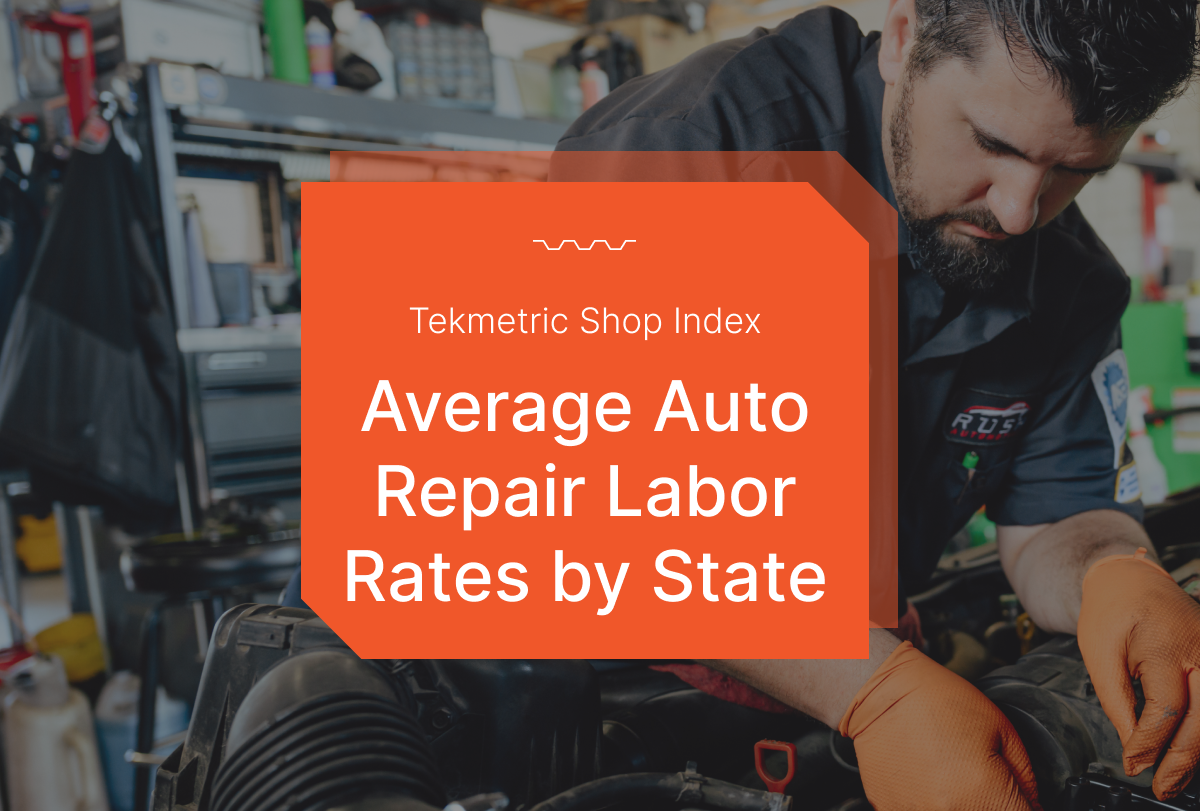
Average Auto Repair Labor Rates by State
June 30, 2026
Read time: 7 min

Request a personalized demo now
experience
Tekmetric in Action
.svg)


.svg)

.svg)
.svg)
.svg)
.svg)
.svg)
.svg)
Platform
Features
- Digital Vehicle Inspections
- Estimate Building
- Parts & Inventory
- Phones
- Reporting
- Payment Processing
- Invoicing
- Text-To-Pay
- Buy Now, Pay Later
- Capital Financing
- Online Booking
- Automated Reminders
- Scheduled Campaigns
- Two Way Texting
- Google Reviews
- Websites
Resources
Support
- help center
- Contact Us
- Tek User Group
- Faqs
- System Status
- Email Preferences
- Brand Assets
- Trust Center
company & Legal
-
Careers we are hiring!
×